Implementation hacks
By design anything can be modelled with the ITOM framework as a TECHNOLOGY either transforming or transporting PRODUCTS. Those technologies are characterised with costs, yields and emissions while constraints can be imposed on the investments, activities and capacities of the technologies. The rest of this documentation describes how the framework’s parameters, variables, and equations are intended to use TECHNOLOGIES and PRODUCTS (and other sets such as REGIONS and LOCATIONS) to model the “real” world. There are of course inherent limitations in what the framework can do as a result of its design.
Here are some examples:
How to model the effects of sub-regional energy prices, when prices for technologies are expected on a larger, regional level? (i.e. the input parameter VariableCost is indexed by REGION but not by LOCATION)
How to observe the benefits (if any) of CCS technology, when it does not produce any actual products that are useful for other production processes? (CCS stand for Carbon Sequestration and Storage, it only uses CO2 as input, does not have a PRODUCT output)
How To measure the value of intermediate products, for which there are no exogenous assumption on the level of demand? (because of the equations’ structure, shadow prices are computed for final products only, i.e. those in the Demand input parameter)
Most such limitations can be overcome by extending the framework, i.e. adding new parameters, variables, and equations in a subclass of the core model class. In the first example above, it would be relatively trivial to index the VariableCost parameter by LOCATION instead of only by REGION to allow for a sub-regional resolution of energy producing technologies, and hence modelling sub-regional energy prices. However, this would require entering costs for each technology in each location, even if the costs are the same across locations of a given region, which is usually the case. It would increase the workload for entering and managing input data as well as the number of equation in the LP problem.
Another way to get the model to answer questions like those listed above, or simply for the model to work as intended, it is sometimes necessary to make certain implementations that are less intuitive, do not necessarily correspond to actual real-world structures (such as real-world processes, products, and capacities), or otherwise stretch the definition or what a TECHNOLOGY or a PRODUCT is. This section explains and summarizes some of the most central “hacks” that can be used to get around such issues.
Restricting invest and use via high costs
Direct limitations on how much the model is allowed to invest in or use a TECHNOLOGY can be set for instance via the parameters LocalTotalAnnualMaxCapacityInvestment and TotalTechnologyAnnualActivityUpperLimit. However, those parameters are not sufficient in many cases. They are indexed only at the TECHNOLOGY level and not MODE-OF-OPERATION level, for instance. Or, more typically, they are not desirable: such hard limits can make the model unsolvable and the cause can be difficult to find, and it can be difficult to maintain an overview the more parameters are involved. Therefore, restrictions can instead often be made via cost parameters (typically CapitalCost or VariableCost). For instance:
Technology A is still at a pilot-level, and is expected to be available only from 2040 🡪 CapitalCost is set to e.g. 1000000 for 2020-2035.
Product X is a toxic gas, and cannot be transported between sites 🡪 VariableCost for the transport_hub technology for Product X is set as 1000000.
In most cases, such high costs are sufficient for the model to avoid the unwanted behaviour. If they are used despite these high costs, i.e. Technology A is invested in 2020 or Product X is transported, it signals a problem which can be identified through the extreme costs.
Note
Pipeline transport passing through locations (pipeline_transfert technologies)
A product can only be transported to a location if there is a technology there that can use the product. But what if a product (e.g., ethylene) is produced in Location A, and should be used in Location C but must be transported via pipeline from Location A, via Location B, to Location C? In the model structure, this transport does not happen by itself, since there is no technology in B that uses the ethylene (it should just be transported onwards to C), and therefore it cannot be imported.
To make this work, we use dummy-technologies named pipeline_transfert_[PRODUCT]. which have no cost and have the same input as output. For instance, a pipeline_transfert_ethylene can then be placed in Location B, allowing ethylene to be transported into B, where it is “used” by this dummy technology, and the “produced” ethylene can be transported onwards to Location C.
Local energy prices
Energy prices can vary considerably in different countries, therefore possibly also within the regions specified in the model if these regions encompass several countries. Consider for example a region such as “West” which would include the Netherlands, Belgium, and the UK. The chemical cluster Amsterdam-Rotterdam-Antwerp (ARA) and UK, both belonging to the model region “West”, however UK has electricity prices almost double that of ARA.
Energy products (e.g. electricity, heat, and steam), are produced in the model via the respective technologies (e.g. electricity_production, HT_heat_production and steam_production). The parameters InputActivityRatio, OutputActivityRatio, and VariableCost that could be used to differentiate these technologies’ inputs, outputs, and costs have a regional resolution by definition.
Without modifying the parameters’ definitions and all related equations, we need a non-trivial approach to capture sub-regional energy prices. In essence, our solution consists of energy production in dummy-locations called ENERGY_CENTER_[REGION], and energy transport to the actual locations via “pipeline” transport. The price of the energy product, e.g., electricity, in e.g. ARA-locations, is in practice set not through the (perhaps more intuitive) VariableCost of “electricity_production”, but through the “pipeline” transport cost to a specific location. Below is a graphical representation of how the modelled system is set up.
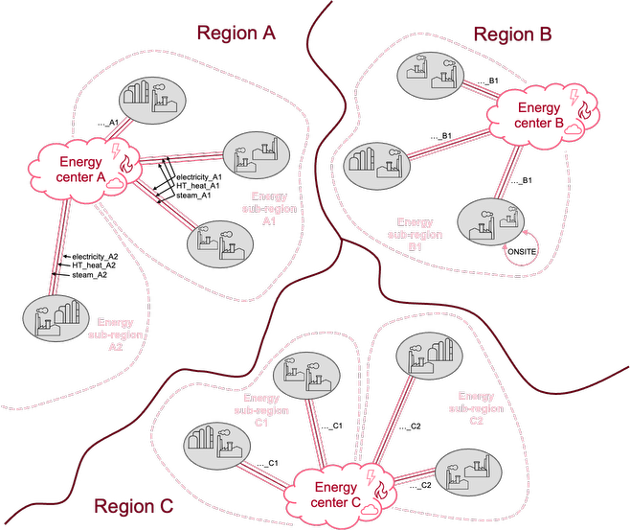
Modelling sub-regional energy prices in ITOM
To implement this in practice, the model input is designed in the following ways:
Each location has beforehand been assigned an energy sub-region, based on the country.
Energy center dummy-locations are given LocalResidualCapacity for the energy production technologies.
New investments in energy production technologies are restricted (via high CapitalCost), so that it cannot be built in any actual production sites.
The energy production technologies produce 1 unit of the respective energy product, at a VariableCost of 1 €/GJ (not 0, in order to prevent any non-used production)
The energy center of a region has “energy pipelines” to each of the locations in that region, defined via:
TRANSPORTMODE (named as [energy product]_[sub-region]),
TransportRoute_pipeline (for each of the TRANSPORTMODEs and respective products, from the energy center of the region, to each of its locations),
TransportCapacity_pipeline (unlimited),
TransportCapacityToActivity, and
TransportCostByMode (equal to the desired energy price in that sub-region, minus 1 due to the VariableCost of 1)
The model input data for this “hack” can be generated automatically in a data-preparation step, after mapping each location to its energy sub-region and entering energy prices for each sub-region.
Fossil input, process emissions, CCS, and CO2 price
This “hack” is implemented in the petrochemical sectoral model (see ITOM-petchem) to track and put a price on both the fossil raw material input and the process CO2 emissions.
Process emissions arise from a range of processes, and are tracked as different CO2 products in the model. The CO2 products include flue_gas_CO2, unavoidable_CO2, and uncompressed_CO2 or and syngas_CO2 (depending on the composition and potential use as syngas component). These emissions can be captured and stored by the respective CCS technologies. However, to be able to price these emissions (and reversely incentivize capture and storage) in the model, additional processes and products have been implemented as follows:
A dummy-technology called EU_ETS produces CO2_allowance products at a VariableCost that represents the CO2 price.
Every technology with (net) output of CO2 products also requires CO2_allowance as an input, equal to the net output of CO2 products. The exception is output of stored_CO2.
Reversely, technologies that have a (net) input of CO2 products (except stored_CO2) give CO2_allowance as an output.
This way, process emissions are priced, unless they are captured or used as an input in a downstream process. Note that no differentiation is made depending on the origin of the carbon, i.e. process emissions are treated equally whether they are fossil, biogenic, from waste, or atmospheric CO2. For many processes, such a distinction would not be practically possible anyway. Instead, in order to incentivise non-fossil feedstock, the model uses a “fossil penalty”.
Fossil feedstock input is penalized, since it is assumed that any fossil material will eventually turn into CO2 emissions, either in production processes or at the end of a product’s life cycle. As the input is fossil and not taken from the atmosphere, this increases the CO2 in the atmosphere. The fossil feedstock input is tracked via the parameter EmissionActivityRatio for technologies that add fossil feedstock to the system (e.g., naphtha_terminal), and priced via the parameter EmissionsPenalty. To model a defossilisation scenario, the parameter AnnualEmissionLimit is set to 0 in the final modelling year. This fossil input penalty cannot be compensated (e.g. with CCS)[1]. But the fossil penalty could also be interpreted in other ways, e.g., as a reverse green premium for recycled/biomass/CO2-based feedstock, or simply as a modelling tool to represent an increasing pressure towards defossilisation.
Waste prices
Recycling of plastic waste plays a central part in the petrochemical sectoral model (see ITOM-petchem). However, future prices for plastic waste are very uncertain. The current waste-pricing approach in the model is based on the assumption that if the waste is not used as an input, it will be incinerated. Incinerating waste produces heat and emissions, where heat would provide revenues according to the price of heat, and emissions would be penalized according to the price of CO2 emissions[2].
The price for waste in the model is thus the opportunity cost or, indeed, revenue of avoided waste incineration. However, one might expect that the waste price would appear in the model as a VariableCost for waste production technologies, but this is not the case. Such an implementation would be unpractical, as the VariableCost parameter would then need to be recalculated and updated by hand every time the assumed energy price or CO2 price is changed.
Furthermore, as the heat prices are sub-regional (see Local energy prices), it would not be possible to give accurate VariableCost values for each energy sub-region. Instead, the waste is correctly priced by using heat and CO2 allowances respectively as inputs and outputs for the waste production technologies. This way, the correct prices are inherited from the heat prices and CO2 prices. It is however important to note that these do not represent any “real” inputs and outputs required for “waste production” and should be filtered out during output analysis, as they are only a way to achieve the correct waste pricing in the model.
More specifically, the heat input (again, representing the opportunity cost of heat from waste incineration) is given for each waste product based on the heating value for that waste. It is represented by the energy product “steam”. For CO2, the waste production technology produces “avoided_incineration_CO2” corresponding to the carbon content of the waste product, in terms of CO2. The opportunity revenue is subsequently gained through the dummy technology “avoided_incineration_CO2_sales”, which has a negative VariableCost according to the assumed CO2 price (note that this is a separate technology from the EU_ETS used to price process emissions).
Tracking shadow prices of intermediate and final products
It is often interesting to know and analyse the “prices” of various (incl. intermediate) products in the modelled system, for example of the final polymers or the HVCs in the petrochemical sectoral model (see ITOM-petchem). For final products the shadow prices resulting from the following constraint deliver marginal supply costs:
PB9_ProductBalance(r,p,y):
    Production[r,p,y] + Import[r,p,y] - Export[r,p,y] >= Demand[r,p,y]
The shadow prices for that constraint represent the cost of producing one more unit of a given product. They thus represent the marginal supply cost of that product, i.e. the production cost of the most expensive production route that is used to produce that product. This can be understood as an estimation of the price of the product within the system (in the following we refer to “prices” for the sake of simplification). Note that the product may be still be produced through cheaper routes, as only the most expensive route used is reflected by the marginal supply costs.
However, the Demand parameter is only required for final products, therefore shadow prices are not calculated by default for intermediary products. To access the prices of intermediate products, we need to use a “hack”. Let’s take the example of the product ethylene, which is a central intermediate product (high-value chamical or HVC) in the petrochemical sectoral model (see ITOM-petchem).
We define a dummy product called “ethylene_demand”, which has a defined Demand of 1 in each region. We define a dummy technology called “demand_of_ethylene” that produces 1:1 the “ethylene_demand” product from “ethylene” at 0 additional cost. This forces the model to produce one more unit of ethylene than is otherwise required to satisfy the demand for the “real” final products, of which ethylene is a precursor. The resulting shadow price from the ProductBalance constraint for the dummy product “ethylene_demand” then represents the marginal supply cost of “real” ethylene.
In summary, to be able to extract the price of any product in the model, three things are needed: a dummy “demand product” to represent the product of interest, a dummy technology to produce the dummy product, and a defined demand for the dummy product.